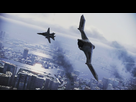
The CFA-44 was developed by the former Soviet Union sometime in the second half of the 20th century. The existence of the aircraft remained unknown to the Western Bloc until reconnaisance imagery spotted one flying near the Romanian Black Sea in the early 1980s.
Initially, the West did not believe it was a vehicle because of its unusual shape, being determined as such only after checking its shadows in nearby clouds. Since no other aircraft was known to have such characteristics at the time, all information pertaining to it remained classified.[1]
Soon after the initial sighting, the Nosferatu was spotted at army bases in Ukraine and Romania. Images of the plane revealed its delta wing design, and two sources of heat were detected by infrared systems. NATO states began to analyze the aircraft and gather information, but assessments of its performance based on images alone did not take place. It was believed that the plane was built by a top design bureau in the USSR, such as Sukhoi or Mikoyan-Gurevich, but the true origins of the aircraft are unknown.
By the time of the Nosferatu's discovery, the West began to assign codenames to Eastern Bloc aircraft. The NATO Air Standardization Coordination Committee (ASCC) gave each plane a simple English word, while the United States Department of Defense assigned codenames according to a certain category (for example, the MiG-29 was called respectively "Fulcrum" or "RAM-L", whereas the Su-27 would be named "Flanker" or "RAM-K"). The CFA-44 was not exempted from this, and was named "Fandance" by NATO in reference to its shape, while the DoD assigned it its own category and named it "Uni-D" (short for "Unidentified-Delta").[1]
Combat service
Later in the decade, the MiG-29 began to be mass produced in 1983, and the Su-27 followed suit in 1985. Shortly after passing the demonstration stage, the Fandance temporarily disappeared from Western eyes. During this time, the United States was developing a radar-invisible stealth aircraft, prompting them to produce faulty blueprints to prevent others from copying the design. The aircraft was unveiled to the world in the late '80s as the "Model-117A", or the F-117A Nighthawk.
In response to the F-117A, the CFA-44 began seeing combat action in various battlefields such as Africa and the Middle East. In this context, the plane gained the attention of the West after combat engagements with American fighters. In one such incident, a downed pilot who faced a Nosferatu described being shot down by "a type of laser weapon", having been hit by the Russian fighter without hearing a single missile alarm. It was also noted that the aircraft tended to intermittently vanish from ground radar.
The public history of the CFA-44 was soon marked by the discovery of a destroyed Fandance found in an African country with relations to the West, along with the remains of its pilot. The wreckage was soon identified as a CFA-44's, becoming the first Fandance in Western hands. Subsequent analysis concluded that the aircraft, which suffered heavy damage, was destroyed in an accident. As well, the investigation revealed important information, such as the existence of a self-destruct mechanism and the use of single crystal engine blades.
~~Bref ce long pavé nous apprend que le CFA-44 est un avion Soviet' datant des années 80 dans notre monde.
Source: http://acecombat.wikia.com/wiki/CFA-44